Sums Application

School Management Solution for Schools, Colleges and coaching institutes.

Author name: Sums_Application_5511

DPDP for Colleges & Universities: Handling Adult and Minor Student Data

Uncategorized

A common myth is that the DPDP Act only protects children. It doesn’t — an adult student’s data is fully protected too, and for first-year or bridge students under 18, the stricter children’s-data regime also applies. Colleges carry an unusually heavy load: admissions and migration records, scholarship and financial-aid data, exam results, hostel and placement information, across multiple departments and campuses. This article explains how higher-education institutions should handle the adult/minor mix and build DPDP into their existing systems.   Adults are protected too — the myth, busted.   The minor/adult mix on one campus.   The heavy data categories in higher education. Scholarship, exam, placement, hostel. Multi-campus governance & retention.   How a college ERP centralises and controls it. FAQ Q: Does DPDP protect adult students? A: Yes — the Act protects all individuals’ personal data, not only children’s.   Q: Do colleges need parental consent for under-18 students? A: Yes, for learners under 18 the children’s-data rules and verifiable parental consent apply.


DPDP for Coaching Institutes: 5 Everyday Mistakes That Could Get You Fined

Uncategorized

Coaching institutes carry outsized DPDP risk because they move fast and run on spreadsheets and WhatsApp. Five habits are the usual culprits: reusing parent phone numbers (collected for fees) to send promotional messages, posting toppers’ photos without specific consent, sharing student lists with edtech partners with no agreement, keeping one open master Excel of every student, and holding on to ex-students’ data forever. Each is now a regulated activity under the DPDP Act 2023. Here’s how to fix all five — without slowing your business down.   Mistake 1: marketing to parents without fresh consent   Mistake 2: results & photos on social media   Mistake 3: handing data to edtech partners   Mistake 4: the open master spreadsheet   Mistake 5: keeping data forever   The fix: consent boxes + access control + retention FAQ Q: Does DPDP apply to small tuition classes? A: Yes — size doesn’t matter; if you process personal data in India, you’re covered.   Q: Can coaching centres still send batch offers to parents? A: Yes, with a separate, specific consent for marketing — not consent collected for fee reminders.

A DPDP Breach-Response Plan for Schools: The 72-Hour Rule, Step by Step

Uncategorized

Under the DPDP Rules 2025, a school that suffers a personal-data breach must inform affected parents without delay and file a detailed report with the Data Protection Board within 72 hours. A lost laptop, a leaked WhatsApp spreadsheet or a hacked account all count. This article gives you a ready-to-adapt breach-response plan: how to detect, contain, assess, notify and document a breach so you meet the timeline and limit the damage. What counts as a breach The 72-hour clock: who you notify and when Parents (without delay) + Board (72-hour report). The 6-step response plan Detect → contain → assess scope → notify parents → report to Board → document & fix. A copy-paste parent notification template How activity logs make all of this possible FAQ Q: How long do schools have to report a data breach? A: A detailed report to the Data Protection Board within 72 hours; affected individuals must be informed without delay.   Q: Is a lost staff laptop a reportable breach? A: If it held personal data and access can’t be ruled out, treat it as a breach and follow the plan.

DPDP Penalties Explained: What a ₹200 Crore Fine Means for a School

Uncategorized

The DPDP Act 2023 carries some of the heaviest data-protection penalties in the world: up to ₹250 crore for failing to keep data reasonably secure, up to ₹200 crore for mishandling children’s data or failing to report a breach, and up to ₹50 crore for other breaches. For education — where most data belongs to minors — the ₹200 crore children’s-data ceiling is the one to watch. This article explains how penalties are decided, what triggers them in a school, and how to avoid the common traps. What actually triggers a fine in a school Leaked spreadsheet, lost laptop, photos without consent, no breach report. How the Board decides the amount Nature, gravity, duration, mitigation. FAQ Q: What’s the maximum DPDP fine? A: Up to ₹250 crore for failing to maintain reasonable security safeguards.   Q: Can a small school really be fined crores? A: Penalties are capped maximums; actual amounts consider gravity and mitigation — but the legal exposure is real.

What Student Data Counts as ‘Personal Data’ Under the DPDP Act?

Uncategorized

Under the DPDP Act 2023, ‘personal data’ is any data about an identifiable individual. In a school that covers far more than names: photographs, date of birth, address, Aadhaar/ID, parent contact details, medical records, fees and payments, attendance, marks, transport and hostel records, and online-learning activity. Most of it belongs to a minor, which triggers the Act’s strictest protections. This article lists exactly what qualifies, with examples, so you know precisely what you must protect. The full list of student/parent personal data Rendered as a categorised table. What makes data ‘sensitive’ in practice Health, financial, biometric — extra care. FAQ Q: Is a student’s photo personal data? A: Yes — a photograph that identifies a student is personal data under the Act.   Q: Are parent phone numbers covered? A: Yes — parent and guardian contact details are personal data.

The DPDP Compliance Checklist for Schools (Free Download)

Uncategorized

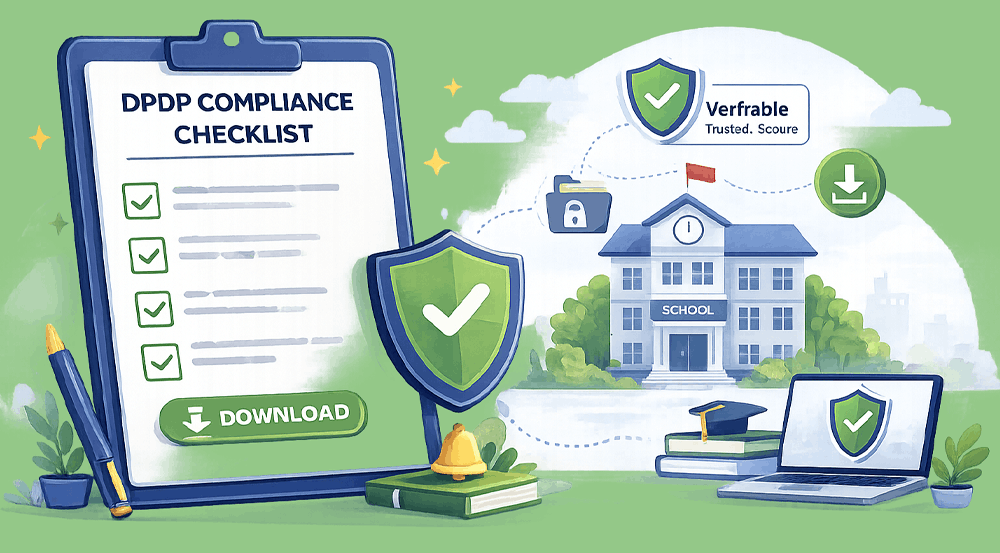
Use this checklist to track your school’s DPDP Act readiness, from appointing a data-protection contact to signing vendor agreements. It distils the DPDP Act 2023 and DPDP Rules 2025 into ten practical, tickable steps a school can actually act on. Download the printable version, work through it with your admin team, and revisit it before the May 2027 deadline. The 10-point checklist  Appoint contact data audit rewrite notices disable trackers classify & protect files parent portal breach plan vendor agreements staff training annual audit What each item protects you from Tie each to a penalty or risk. FAQ Q: Is this checklist enough to be DPDP compliant? A: It’s a strong start, but full compliance also needs policies, training and legal review.   Q: Who should own DPDP in a school? A: Appoint a named data-protection contact and publish their email, as the Rules expect.

Verifiable Parental Consent Under DPDP: How Schools Should Actually Collect It

Uncategorized

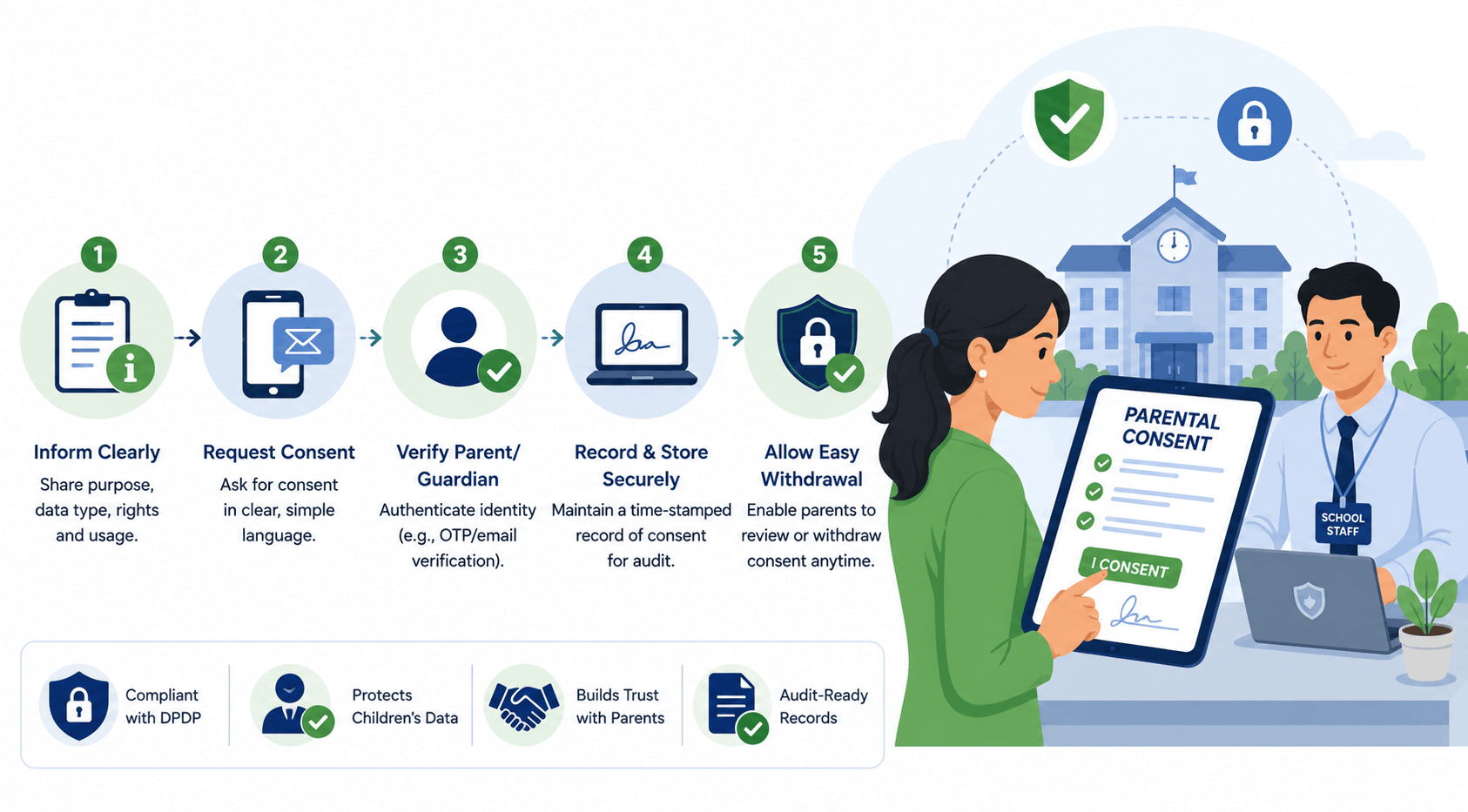
Verifiable parental consent means the consent is provably tied to the actual parent or guardian of a specific child — not a box the student ticked. Under the DPDP Rules 2025, schools must collect this before processing a child’s personal data for most purposes. Acceptable methods include a signed admission form with parent ID proof, an OTP to the parent’s registered mobile, video-KYC at enrolment, or a digital signature via DigiLocker. This article shows exactly how to build a compliant consent flow into your admission process — with a purpose-by-purpose breakdown. What ‘verifiable’ really means The link-to-the-real-parent test; why a student tick-box fails. Four acceptable methods, compared Signed form + ID, OTP, video-KYC, DigiLocker — pros/cons table. Purpose-specific consent (the part schools miss) Separate boxes: academics, fees, photos, edtech sharing. Building it into admission (and re-consent) Timestamp, audit log, withdrawal mechanism. FAQ Q: Is a tick-box on the admission form enough for DPDP? A: No — it must be verifiably tied to the parent, e.g. signed form with ID, OTP, video-KYC or DigiLocker.   Q: Do schools need fresh consent for posting photos? A: Yes — photos are a separate purpose and need their own consent.

Are Schools Exempt from DPDP Children’s-Data Rules? The Fourth Schedule, Explained

Uncategorized

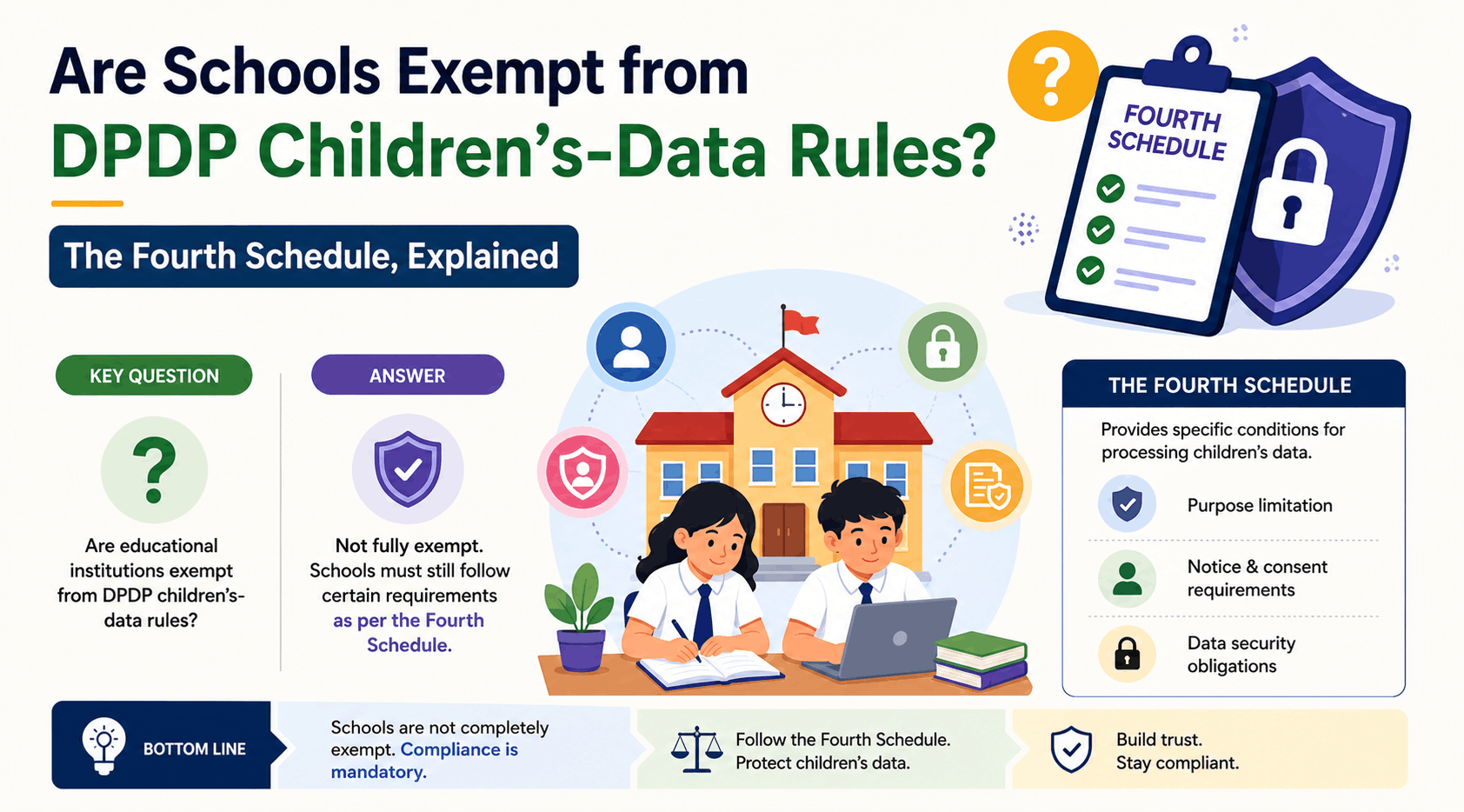
Partly — but not blanketly. Under the DPDP Rules 2025, certain classes of Data Fiduciaries, including educational institutions, are granted limited relief from some children’s-data obligations (such as aspects of verifiable parental consent and the bar on tracking) — but only for specific, listed purposes tied to the child’s welfare, safety and education. It is not a free pass. This article explains what the exemption likely covers, what it does not, and why most of a school’s data processing still needs full consent and safeguards. What the relief is meant to cover Safety, attendance/monitoring for welfare, educational activities — the operationally necessary processing. What is NOT exempt Marketing, photos on social media, sharing with edtech partners, behavioural ads — still need consent. FAQ Q: Are schools fully exempt from DPDP consent rules? A: No. Relief is limited to specific welfare/education purposes; most processing still needs verifiable parental consent.   Q: Can schools track students under the exemption? A: Only where strictly tied to a permitted purpose such as safety; general behavioural tracking and ads remain prohibited.

DPDP Rules 2025 Explained for Schools : What Changed and Your May 2027 Deadline

Uncategorized

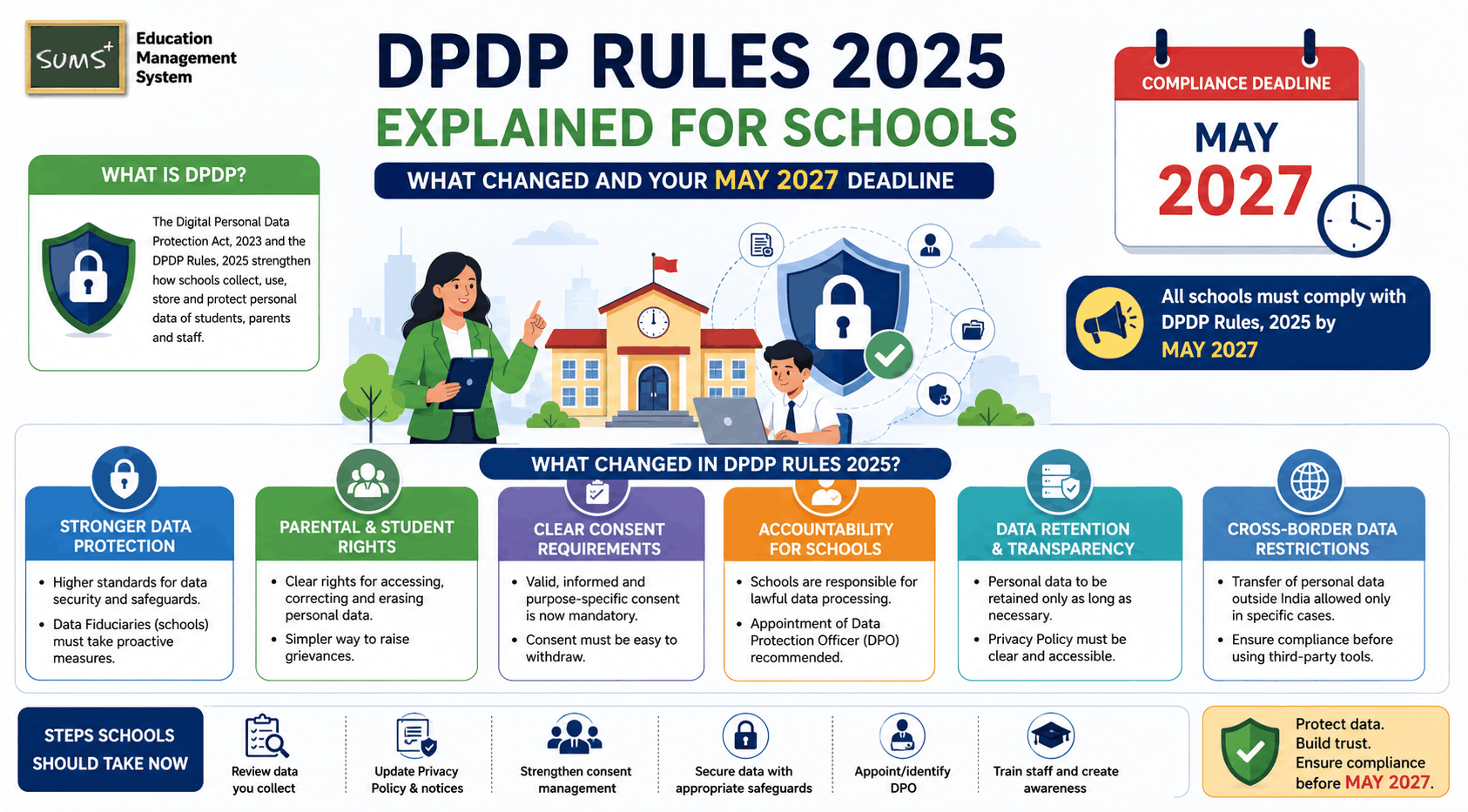
The DPDP Rules 2025 were notified by MeitY in November 2025, turning the DPDP Act, 2023 from a principle into an enforceable regime. For schools the practical takeaway is a countdown: most substantive obligations — notices, consent, security safeguards, breach reporting and retention — apply from around 13 May 2027, while Consent Manager provisions come in around November 2026. This article breaks down exactly what the Rules added, what schools must do at each phase, and why starting now is the cheapest path to compliance. The phased timeline (immediate / 12 months / 18 months) What activates when, in a simple table. What the Rules newly require Standalone itemised notices; verifiable parental consent mechanics; 72-hour breach reporting; retention & erasure triggers; security baselines (access control, log retention). What it means for a school, step by step A short to-do list mapped to each phase. The cost of waiting Why a 9–12 month programme means starting in 2026. FAQ Q: When were the DPDP Rules notified? A: In November 2025, via gazette notification by MeitY.   Q: What is the DPDP deadline for compliance? A: Most substantive obligations apply ~13 May 2027; some Consent Manager provisions ~November 2026.   Q: Do schools need to start now? A: Yes — typical compliance programmes take 9–12 months, so 2026 is the time to begin gap assessment.

DPDP Act 2023 for Educational Institutions in India: The Complete 2026 Guide

Uncategorized

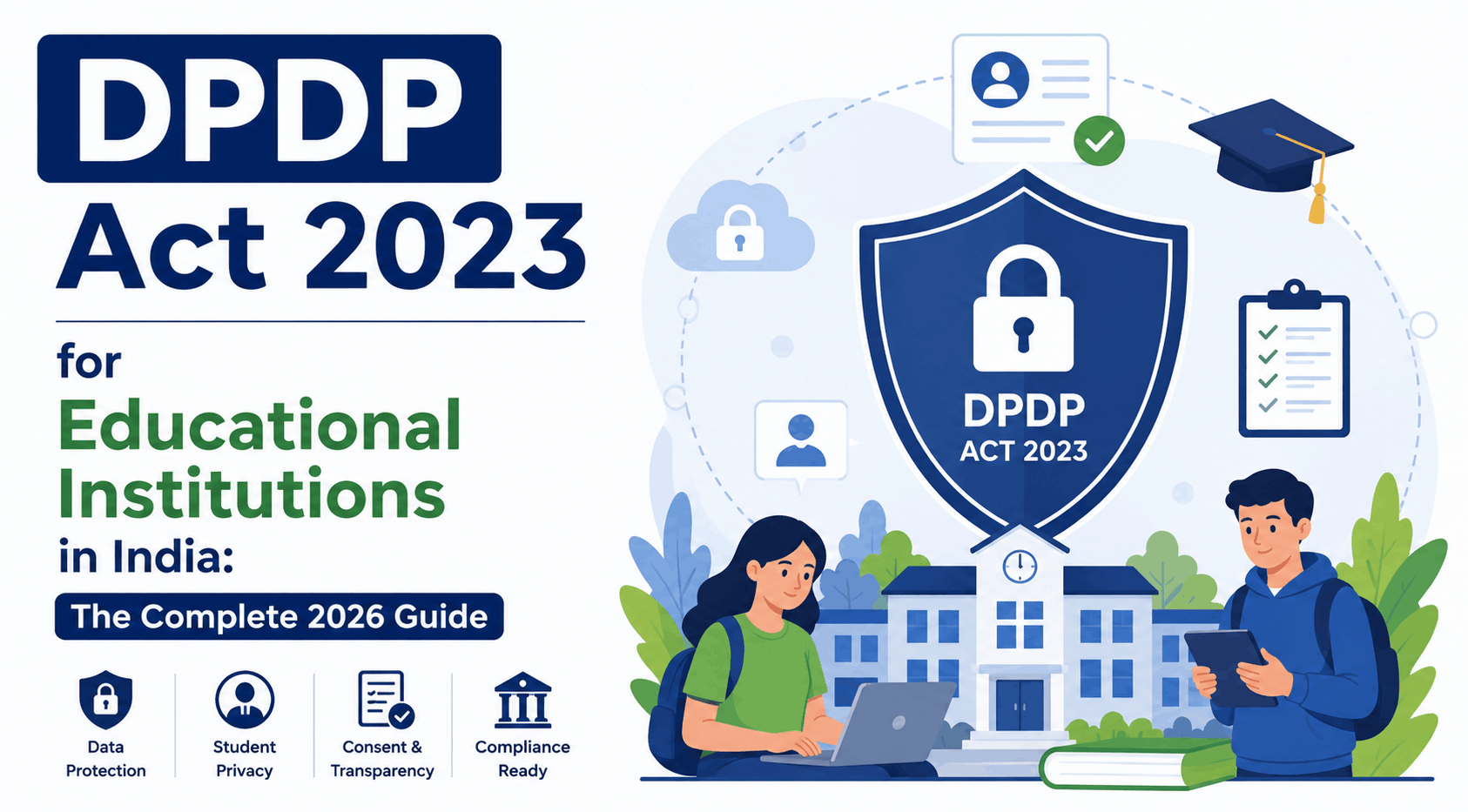
The Digital Personal Data Protection (DPDP) Act, 2023 applies to every school, college and coaching institute in India that collects or processes student or parent data — which is all of them. Because most learners are children under 18, education is among the highest-risk sectors under the law. With the DPDP Rules 2025 notified in November 2025, substantive obligations take effect from around 13 May 2027, giving institutes a limited window to get ready. This guide explains, in plain language, what the law requires, what changed with the Rules, the penalties, the children’s-data regime, and a practical 7-step roadmap. What the DPDP Act is, in one minute The first comprehensive data-protection law in India; protects ‘digital personal data’. Key roles: Data Principal, Data Fiduciary (the institute), Data Processor (vendors). Why education is high-risk Most learners are minors; Section 9 children’s-data regime applies. Volume and sensitivity of data — IDs, medical, fees, photos. What changed with the DPDP Rules 2025 Notified Nov 2025; phased rollout; full obligations ~May 2027. Itemised notices, breach 72-hour reporting, retention triggers, security baselines. The penalties ₹250 cr / ₹200 cr / ₹50 cr — with a worked example. The 7-step roadmap Discover → Consent → Children → Secure → Rights → Breach → Vendors. How SUMS ERP + Siccura Regula map to each step Two-layer table: structured ERP data + unstructured files. FAQ Q: Does the DPDP Act apply to small coaching classes? A: Yes. The Act applies to any organisation processing personal data in India, regardless of size. Q: When is the DPDP compliance deadline for schools? A: The Rules were notified in November 2025; most substantive obligations apply from around 13 May 2027 (an 18-month runway). Q: What is the maximum penalty under the DPDP Act? A: Up to ₹250 crore for failing to maintain reasonable security safeguards. In short, an Education Management Platform is not just a tool for administrators; it’s a consent, data accuracy, secure storage, data breach response; rights provided access, correction, erasure, grievance redressal.

Scroll to Top