
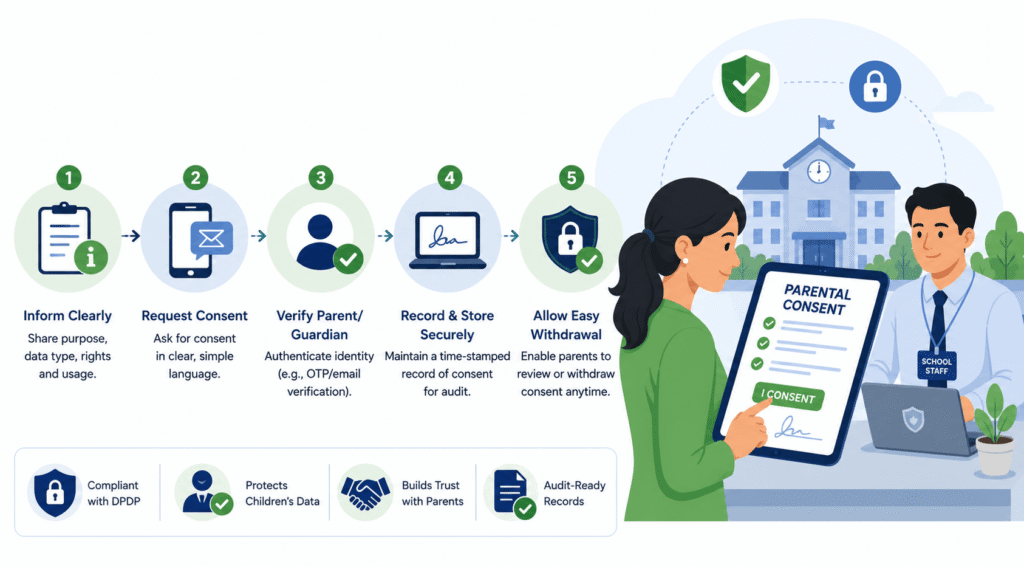
Verifiable parental consent means the consent is provably tied to the actual parent or guardian of a specific child — not a box the student ticked. Under the DPDP Rules 2025, schools must collect this before processing a child’s personal data for most purposes. Acceptable methods include a signed admission form with parent ID proof, an OTP to the parent’s registered mobile, video-KYC at enrolment, or a digital signature via DigiLocker. This article shows exactly how to build a compliant consent flow into your admission process — with a purpose-by-purpose breakdown.
What ‘verifiable’ really means
- The link-to-the-real-parent test; why a student tick-box fails.
Four acceptable methods, compared
- Signed form + ID, OTP, video-KYC, DigiLocker — pros/cons table.
Purpose-specific consent (the part schools miss)
- Separate boxes: academics, fees, photos, edtech sharing.
Building it into admission (and re-consent)
- Timestamp, audit log, withdrawal mechanism.
FAQ
Q: Is a tick-box on the admission form enough for DPDP?
A: No — it must be verifiably tied to the parent, e.g. signed form with ID, OTP, video-KYC or DigiLocker.
Q: Do schools need fresh consent for posting photos?
A: Yes — photos are a separate purpose and need their own consent.